
@AmericanAir – American Airlines War On the Consumer

March 11th, 2013   •   no comments   

A few weeks ago American chef, Anthony Bourdain, began a Twitter rant against American Airlines. The reason? Yet another delayed flight.

@Bouradain’s complaint wasn’t just about the delay but also about the way that American Airlines handled it.

As American Airlines tends to do, it left stranded passengers without useful information about the status of the flight.

The passengers just had to sit there and wait.

The Twittersphere was humming and passengers were in rebellion mode. This can’t be a good for the brand, especially for an airline that’s in bankruptcy.

Yet, brand building seems to be the last thing @AmericanAir worries about, as the two incidents below demonstrate.

How American Airlines Stole Christmas Twice

Dr Ariane David How American Airlines Stole ChristmasDon B. wanted to fly from Los Angeles to Seattle on Christmas Eve, 2012. He was looking forward to spending the holidays with his family whom he hadn’t seen in some time.

In October he made reservations for himself and a friend using American Airlines‘ online reservation site.

The site was difficult to use, froze up and lost his data a number of times.

It took Don, a veteran web developer, five tries to successfully enter his information, but finally the reservations went through, and confirmation was sent to his email address.

The day before the flight Don tried to check in online, but he got an error message saying simply that he’d have to check in at the airport.

There was no indication of what the problem was. He thought nothing of it and went to the American Airlines counter to check in the next day.

No Information Available

The person at the counter reiterated that there was a problem with his reservations, but she couldn’t give him any information. He would have to call American Airlines central reservation desk and speak with them directly.

Since they had no direct phone line that he could use, he had to use his cell phone.

Only when he called did he find out the problem: both seats were in his friend’s name (remember the glitchy reservation web site?).

Don’s friend could travel in whichever of the two reserved seats she wished, but he would have to buy a new ticket if there was room on the plane (of course there was room – he had two tickets!)

Don asked to speak a supervisor. The supervisor’s opening salvo was a scolding to Don for the quality of the cell phone transmission. The call went downhill from there.

Don explained that the error was with American Airlines’ web site. They were obviously aware that he was the main passenger, since all travel information was addressed to him, and not to his friend with the two seats.

Cancelled!

But the supervisor, unrelenting in her abrasiveness, said, no matter, the onus is on the customer to catch the error. He could still fly that night, however, he would have to buy a new ticket. Don said OK. But the price she quoted was far in excess of what he’d already paid.

He ended up passing on her offer and missed the Christmas family reunion.

There’s more. Don’s son, who had flown to Seattle for Christmas, decided to come to Los Angeles to visit Don. He got up at 4:00 a.m. to board the 6:30 a.m. Alaska Air flight that took him to San Francisco and would connect to his 9:30 a.m. American Airlines flight on to Los Angeles.

Passengers Got Their Information from their Phones .. NOT American Airlines

The flight boarded, taxied, but was forced to return to the terminal. The cause was a mystery to the passengers and the airline wasn’t telling.

The flight was delayed one hour, two hours, four hours…eight hours…the passengers waited for information.

Those who had access to smart phones were able to get some information online.

After nines hours the flight finally took off.

It Wasn’t What Happened…It Was How American Airlines Handled It

Airplanes are complicated things: stuff happens to them. Better delay than death. But once again delay was not the only issue. Equally important was how American Airlines handled it.

The flight wasn’t delayed because of weather, or war or extraterrestrial hanky panky: the flight was delayed as a result of an internal problem with American Airlines.

It would not have required magical thinking to expect the airline to offer passengers some comfort during the nine hours.

They recieved a single breakfast voucher immediately upon deplaning (had the passengers known they’d be stranded for so long they could have eaten their Fruit Loops one at a time and made them last the whole day).

Live Twitter Feed #AmericanAirlines

Nine Hours Later

Dr Ariane David How American Airlines Stole Christmas
You have to wonder what would make an airline hold their customers captive for the equivalent of a whole working day without useful information.

Certainly it was evident early on to American Airlines that this wasn’t a one hour glitch, so did they consciously misrepresented the severity of the problem and the duration of the delay?

A strategic move perhaps: by parcelling out snippets of worthless information they were able to keep most of the passengers close to their own gate and not on other airlines.

My guess is that if the passengers had known right off the bat how long the delay was projected to be, there would have been a stampede to other airlines,  and that would have been expensive for American Airlines.

Don and his friend subsequently wrote to fifteen different American Airlines executives to relate their story and that of his son. Interestingly, out of all those letters, the only reply came from Steve Lasner on behalf of American Airlines’s general counsel, Gary Kennedy.

When a Corporate Attorney Answers a Customer Service Question…the Customer Must Be The Enemy

Why would a company who valued its customers answer a first-contact customer service issue through their corporate attorney? The answer is, they wouldn’t. Only a company who saw customers as a threat would do that.

Mr. Lasner explained that American Airlines is not responsible for their web site: “when a you buy tickets online you’re acting as your own travel agent” and problems are the responsibility of the customer, not American Airlines.

This refrain was too familiar. (I find myself wondering what American Airlines would do if suddenly all customers booked by phone.)

And yet the communication from Mr. Lasner did not have to be the disaster it was. The only thing he needed to do for Don and his friend was to show that he – that American Airlines – cared. But clearly caring for customers is not an American Airlines priority.

Sadly, there may not be any relief in sight for customers with the upcoming American Airlines-US Airways merger. In a sense it’s an understandable pairing given that these two airlines seem to be vying for he same top spots in the Department of Transportation’s list of the most complained-about US-based airlines.

American Airlines Ranks as the Third Worst Airline in Customer Service

Dr Ariane David How American Airlines Stole ChristmasIn 2012 American Airlines ranked third worst out of sixteen; US Airways ranked fourth, an improvement over their 2011 rank of second most-complained-about airline.

In a recent letter to customers, American Airlines CEO Thomas Horton raved about the great variety of travel options that would be available to passengers due to this merger, yet he managed to say not a word about improved customer service. This is not reassuring to American Airlines regulars.

Contrast that to Southwest Airlines who regularly ranks as America’s least complained about airline. They herd you, they box you, and finally funnel you down a chute to scramble for seats, and somehow it’s OK, because you get the feeling that Southwest likes you. Now that’s brand management.

Dr Ariane David How American Airlines Stole Christmas

I suspect that American Airlines will punish the reservations supervisor. It’s typical for organizations like American Airlines that eschew responsibility for the culture they created and harbor to blame minor functionaries for manifesting that culture.

@BevGoulet
@PeterWarlick
@SteveLasner
@GaryKennedy
@AmericanAir
@bourdain
#bourdain
#americanairlines

Thinking That Transforms Everything

May 25th, 2012   •   no comments   

Presentation to PMI/LA

View more The Veritas Group

Miracle on Manchester: How Success Betrays Us

February 14th, 2012   •   1 comment   

The Single Greatest Moment in Stanley Cup History

In 1982 the Kings finally made it to the playoffs. This was not particularly momentous since the Kings had made it to the playoffs the four preceding years, just to be eliminated in the first round. In spite of that, the Kings were my team and I loved them. Yet these days I often felt like a jilted lover as they regularly botched easy shots and lost games to lower ranked teams.

They hadn’t always been this way. In the ’70s they held their own, and they even had a decent enough 80-81 season. But then in ’81-’82 they took a nose dive. Their total goals were well below the NHL average and when it came to preventing goals, it sometimes looked as though they were playing for the other team.

Third Game of the First Round
Kings LogoThis was third game of the first round 1982 playoffs: Edmonton Oilers led, by the greatest of the greats, Wayne Gretsky, against the Kings. In light of the Kings recent record, it was understandable that the Oilers, and just about everyone else, expected an easy win for the Oilers.

The game went as expected; the score at the end of the second period was Oilers – 5, Kings – 0. Before the Zamboni had finished half the ice, the stands were half empty. Clearly there wasn’t much interest in witnessing the final humiliation.

Wayne Gretsky in an Interview

Sometime later Wayne Gretsky acknowledged that in the Oilers locker room that night after the second period they made fun of the Kings. Not for a single instant did they doubt that they knew exactly how the Kings would play the final period or that the game would end in an Oilers’ victory.

Why the Oilers Strategy Failed

Let me back up here and say something about the Kings’ strategy. The Kings had been successful in the ’70s using a conservative defensive strategy, based on preventing opponent goals in low scoring games. Miracle on Manchester 1982 Stanley Cup FinalsAs people tend to do, they held tight to their winning model never questioning it as time went on.

The beginning to the ’80s saw a shift in the game. The times were changing, as they inevitable do, but the Kings didn’t notice. The game turned fast and offensive, and the Kings seemed unable to adapt. That night in April, 1982 the Kings were again working their obsolete strategy, and it was bringing them ruin.

Back in their locker room, the Oilers were cocky and laughing, and vowing to stick to their strategy. They were ahead five goals, an impossible number to make up, especially by the Kings. Believing they had nothing to lose they decided to continue playing fast and risky, concentrating on racking up as many goals as possible, rather than preventing the Kings from scoring.

Kings Desperation Opened the Way to Insight

In the Kings’ locker room, desperation opened the way to insight: they would finally change their thinking and their strategy. Banking on the notion that the Oilers, certain of their win, would continue with their strategy of favoring goals over blocking , the Kings decided that in the next period they would concentrate on scoring, but they would do it in a focused, methodical way, making each move count.

The Oilers Never Saw it Coming
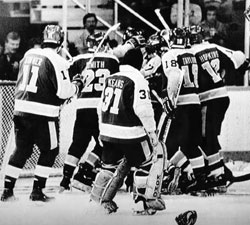
Miracle on Manchester 1982 Stanley Cup FinalsIn the third period the Kings came back and scored and scored again until with a little over three minutes to go in the game the score was 5-4 Oilers. The Oilers never saw it coming. Then the unthinkable happened: thirty seconds before the end of the third period the Kings made the final goal of the period tying the score at 5-5, sending the game into overtime.

Another intermission. No one left the stands. Then history was made. Two minutes and 35 seconds into overtime the Kings scored. The game was won in what has been call the single greatest moment in Stanley Cup history.

The Thinking Behind the Strategy

This game has been analyzed many times from many different perspectives.

Miracle on Manchester Stanley Cup Playoff 1982For me the most interesting perspective has to do with the thinKing that went behind this game, the thinking of the Kings and of the Oilers. The Kings were so mired in their beliefs about the strategy that had brought them victory in the 70s, that even in the light of their spectacular under-performance in the 80s, they never questioned it, not until that night in 1982.

It Cost the Oilers the Game
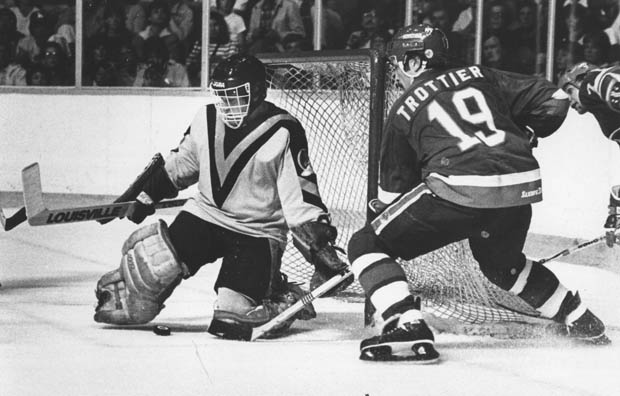
Miracle on Manchester 1982 Stanley Cup FinalsThe Oilers, giddy from their success that night, never asked themselves if there was something more they should be thinking about or if there was something they weren’t seeing. They assumed that the end of the game would be like the beginning, but it was not. Their taken-for-granted thinking cost them the game.

Both teams were so betrayed by their successful strategy that they didn’t bother to question the thinking or assumptions behind it. Fortunately for the Kings, in the kind of breathtaking inspiration that comes out of desperation they did break through and won the game.

I was there that night, and I did not desert my Kings. This time they rewarded my love.

Besides the Oilers, the losers were Jerry Buss, who assumed the Kings’ loss and went home and those spectators who decided en masse that there was nothing more to be seen and left before the dazzling third period.

If you have any questions about critical and strategic thinking please send me a note from our contact page or email me at ADavid[at]theveritasgroup.com.